
A 3D-printed support bracket I designed to hold long material level with the front passthrough of the Monport Reno45 Pro, making oversized material easier to position and engrave.
The Problem
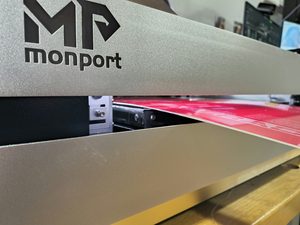
The front passthrough on the Monport Reno45 Pro makes it possible to engrave material longer than the laser bed, but there was one problem: once the material extended out the front of the machine, there was nothing supporting it.
That meant longer pieces could sag or tilt as they came out of the passthrough. For engraving, I wanted the material to stay as level and stable as possible without having to stack random objects in front of the laser every time I used it.
Since I had already designed a modular 3D-printed cover for the front passthrough, I decided to make a support that could work with the same area of the machine.
The Build
I wanted the support to be simple and removable.
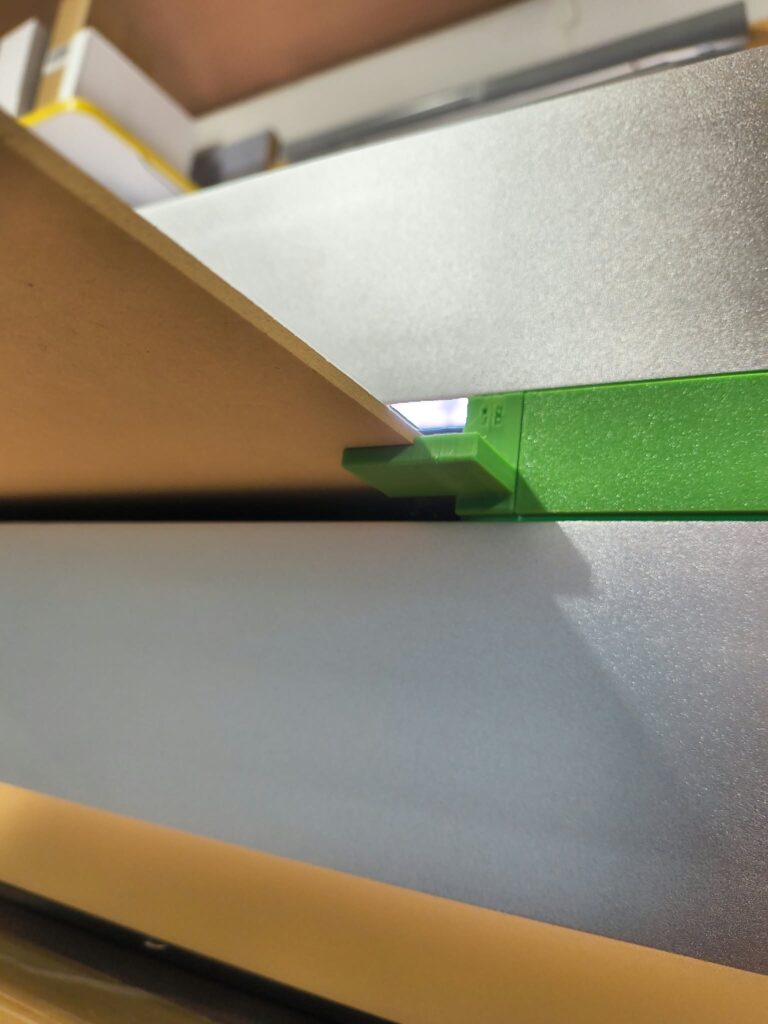
I designed a pair of brackets that fit the rail of the front passthrough to support material extending out of the machine. The parts were printed in Hyper PLA on my Creality K2.
The goal wasn’t to build an elaborate system. I wanted something I could install when I needed it and remove when I didn’t.
Test
Once it was printed, I installed the support on the Reno45 and tested it with material extending through the front passthrough. I then modified the file to create two different sets, one for 1/8″ material and one for 1/16″ material.
It worked well enough that the prototype became the version I’m actually using on the machine.
Learn
This was a good example of why I like having a 3D printer in the shop. The problem was extremely specific to my setup, and buying a generic solution would either require modification or take up more space than I wanted.
Instead, I could design around the machine, print a prototype, test it, and make changes based on how it actually behaved.
It also gave me another idea: the same basic concept could eventually be developed into a heavier-duty version for supporting larger or heavier material.
What’s Next
The current version works for what I need, so I’m going to keep using it and see how it holds up over time.
I may eventually build a heavier-duty version with a wider support surface or roller and an adjustment range that doesn’t require swapping out the 1/8 and 1/16 support brackets. For now, though, this version solved the problem I designed it to solve.